
Stop Faking City Pages: How to Actually Rank Where You Don't Have an Office
Authors


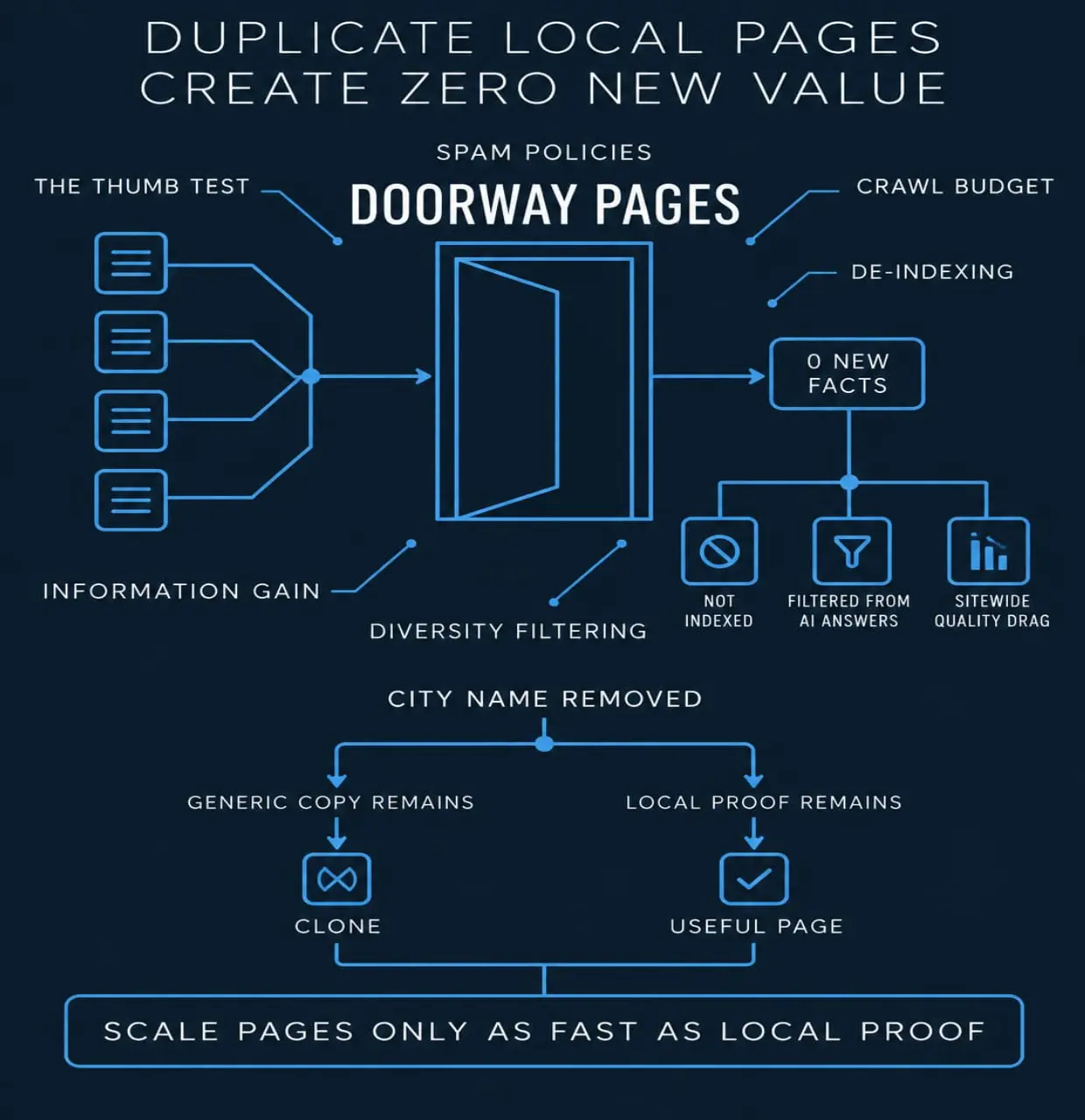
A personal injury law firm wants clients in 50 cities. It operates real offices with practicing attorneys in five of them. How do you capture that regional traffic without triggering spam filters? The tempting shortcut to rank without a physical address is to publish 50 web pages that swap only the city name and funnel every visitor into one central case intake form.
Search engineers call these doorway pages, and the enforcement against them is active, automated, and now extended into AI-driven search results. The team at AI Search Strategies reviewed the field research on location pages in AI search, and the outcomes are consistent enough to treat as settled.
This article walks through what doorway pages are, five documented case studies showing exactly what happens when businesses deploy them, and the architecture that works instead.
Doorway Pages Are Fake Entrances to the Same Room.
Picture a hallway in a shopping mall with 20 storefront doors labeled “Oakville Personal Injury Lawyers,” “Burlington Personal Injury Lawyers,” “Hamilton Personal Injury Lawyers,” and so on. Every door opens into the same tiny room with a single intake phone line. You would feel tricked. The extra 19 doors existed only to capture you.
Search engines evaluate doorway pages the same way. Google's spam policies define them as pages built to rank for similar location queries while funneling visitors into a central destination that delivers less usefulness than the searcher expected.
Google's human quality raters are instructed to assign the lowest quality score to pages where the main text lacks originality and adds nothing beyond what other pages already provide. This applies whether a database script, an AI tool, or a human copywriter produced the text.
The enforcement timeline is long and recent. Google named doorway pages in its guidelines by 2007, targeted them algorithmically in 2015, renamed the violation doorway abuse in 2024, and extended the spam policies into AI Overviews and AI Mode. Doorway penalties are a current enforcement priority, and this is commonly misunderstood as a historical issue.
The Thumb Test Separates Clones from Champions.
Local SEO auditors use a simple diagnostic. Place your thumb over the city name wherever it appears on the page. Read what remains.
If the remaining text contains useful, accurate information that applies only to that specific town, the page passes. If removing the city name leaves generic marketing copy that could describe any town in the country, the page functions as a doorway.
Defensible local pages contain operational proof:
- How local building codes govern installations
- How regional weather events shape material choices
- Specific dispatch zones and travel policies
- Customer reviews tied to local streets, with geo-tagged job photos
- A complete local booking path instead of a generic contact form
Templated clones replace all of that with a find-and-replace operation on city names. The body text runs 80 to 95 percent identical across pages. Search systems measure that overlap directly.
Google Runs Every Page Through a Five-Step Inspection.
Search crawlers operate under a finite computing allowance known as a crawl budget. When Googlebot fetches a new location page, the document moves through a defined evaluation sequence.
- Discovery: The crawler discovers and fetches the page.
- Rendering: The renderer extracts visible text, links, and structured data.
- Comparison: The system compares the text and template against the site's existing pages.
- Information check: It calculates whether the page introduces any new facts.
- Indexing decision: It decides whether the page earns a place in the main index.
When Google Search Console reports “Crawled, currently not indexed,” that status reflects a deliberate quality judgment. The engine examined the page and concluded it adds nothing meaningful beyond URLs already on the domain.
Publishing hundreds of templated pages produces index bloat. Low-value duplicates consume the crawl allowance that your genuinely valuable commercial pages need, which delays their discovery and refresh. This operational cost is index bloat in practice, and it compounds as the templated footprint grows.
Five Case Studies Show the Full Range of Outcomes.
Case 1: Mass De-Indexing Across 200+ Service Businesses
Schieler Mew, admin of the Google SEO Mastermind group, analyzed more than 200 service-area business websites following Google's 2022 helpful content and spam updates. Sites with low authority or thin content across the domain saw their duplicate location pages de-indexed in bulk, erasing their peripheral keyword rankings. Location pages on sites with strong authority and genuinely helpful content held their positions.
The lesson: algorithm updates target the architecture, and genuine local pages ride through them.
Case 2: 200 AI-Generated Pages, Zero Visibility
Research agency Sterling Sky published over 200 AI-generated location pages on identical templates. The pages sat permanently in “Crawled, currently not indexed” status. They generated zero impressions and zero visibility. The experiment produced nothing except wasted production cost.
Case 3: 3,000 Human-Written Pages Earned a Manual Penalty
A nationwide home service provider hired human copywriters to produce 3,000 unique city pages, each funneling bookings into a central call center. Google issued a sitewide manual penalty for thin content with little added value, a case documented by Sterling Sky after the business owner reported it on the Local Search Forum.
The lesson: human authorship does not exempt a doorway funnel. The penalty attaches to the architecture when the pages lack standalone utility.
Case 4: The 35-Page Exception That Confirms the Threshold
A regional lawn care contractor published 35 service area pages with 84 to 85 percent content similarity. All 35 indexed, ranked on page one, and generated sales, according to Sterling Sky's review of the account.
Two conditions explain the exception. The targeted townships had zero competing optimized content, so the engine lowered its quality threshold to answer user queries at all. And 35 pages sits well beneath the statistical volume that triggers scaled-content filters. Scaling the same template into hundreds of URLs triggers automated suppression.
Case 5: Deleting 198 Pages Grew Traffic 37 Percent
Auditors evaluating a 600-page enterprise domain found that 198 programmatic location pages drove only 3.1 percent of total traffic. The company removed all 198 URLs and consolidated them into comprehensive regional hubs with permanent redirects. The full data set appears in a Search Engine Land content pruning case study.
Domain-wide organic clicks grew 37 percent after the pruning. Removing the doorway footprint lifted the drag from sitewide quality classifiers and concentrated internal authority into pages that deserved it.
The lesson across all five cases: the correct response to a doorway problem is consolidation. Rewriting 120 town pages with more filler produces longer near-duplicates, which remain near-duplicates.
AI Search Engines Score Novelty, and Duplicates Score Zero.
Conversational platforms including Google AI Overviews, ChatGPT Search, Perplexity, and Gemini retrieve web passages and synthesize them into direct answers. Two mechanisms inside that process eliminate copy-paste pages, and both can be explained without formulas.
The first is Information Gain scoring, formalized in a Google patent. The system tallies the verifiable facts, numbers, and local details in your page, then subtracts everything it already learned from other pages on the topic. Whatever remains is your score. A templated city page that repeats the same service description with a swapped city name contributes nothing new, so its score sits at effectively zero, and the engine skips it when assembling an answer. A page can hold a strong organic ranking and still fail the Information Gain threshold required for AI citation, which is why firms with solid Google positions receive zero mentions in ChatGPT or Perplexity. This is the AI Visibility Gap™ in measurable form.
The second is diversity filtering. Before feeding passages into its answer model, the retrieval system compares candidates against passages it already selected. When two passages say nearly the same thing, the duplicate gets pruned to preserve limited working memory. Twenty templated city pages read as near-identical to the system, so nineteen of them get discarded before synthesis even begins.
Geographically contextualized pages avoid both filters. Local building code details, historic weather challenges, and neighborhood-specific reviews keep cross-page similarity low and novelty high, which earns direct citations in AI answers.
Match Your Search Architecture to Your Operational Proof.
The safe path forward scales your website in proportion to your demonstrable practice presence. Three tiers cover the realistic situations for a personal injury firm.
Tier 1: No office or case history in the target city. The safest foundation of local SEO for service areas is to publish one comprehensive service-areas directory page for the full metro region. Include a map of the counties and courthouses the firm handles cases in, consultation policies for hospital visits, home visits, and virtual meetings, and an explicit list of covered towns. Create no thin child pages.
Tier 2: Staffed offices or steady case volume in 5 to 15 core municipalities. Build dedicated city hub pages strictly for those core towns. Embed office-specific client reviews, named attorneys practicing from that location, local courthouse and filing details, jurisdiction-specific case results with the disclaimers your state bar requires, and native case intake forms on each one.
Tier 3: Occasional cases spread across dozens of towns. Skip static city pages entirely. Publish a case results log instead, with individual anonymized case study pages tagged by municipality, accident type, and outcome, linked back to your main practice area hubs.
Across all tiers, structure matters. Location pages belong in a browsable tree: a top-level service-areas hub, regional hubs grouping neighboring towns, city hubs beneath them, and case results logs linking upward. Pages buried in footer mega-menus and linked from nowhere else read to crawlers as isolated islands, which is one of Google's five diagnostic signals for doorway behavior.
Add structured data that tells the truth. Define the areas you serve with precise administrative boundaries and exact coordinates, and apply legal service markup only where the page describes a staffed office with practicing attorneys. Listing virtual offices or manufactured addresses to justify markup creates the exact validation failure that AI engines check against third-party records such as state bar directories and Google Business Profiles.
Three Takeaways for Established Local Businesses.
First, volume works against you. Mass-produced city pages drain crawl budget, land in unindexed status, and depress sitewide rankings. Thirty-five pages in an empty market indexed once. Two hundred templated pages produced zero visibility. Three thousand human-written funnel pages earned a manual penalty.
Second, the Thumb Test is your compliance check. Cover the city name. If generic text remains, the page is a liability, and the documented fix is removal and consolidation into stronger regional hubs. One case study converted that pruning into 37 percent organic growth.
Third, AI search pays for new information only. Conversational engines cite pages that contribute verifiable local facts beyond what they already ingested. Your real-world reputation earns those citations only when your digital footprint makes the local proof machine-readable.
Expanding into new cities remains one of the most reliable growth paths for an established personal injury firm. The firms that master service area SEO in AI search will be the ones whose digital footprint documents named attorneys, verified case results, and working knowledge of each local courthouse. The practical first step is to run the Thumb Test on your current location pages, keep the ones that carry genuine local proof, and fold the rest into regional hubs that can expand as your caseload in each city grows.
Is your business invisible to AI?
Get a manual expert analysis to uncover why you aren't being recommended.
Get Your Free AI Visibility Quick Win Review