
SEO AI vs. Traditional SEO: What Referral-based Service Providers Must Change
Authors


A homeowner in Ottawa asks ChatGPT to recommend a licensed general contractor for a basement renovation. A local contractor with five years of consistent Google rankings and 80 reviews gets zero mentions. A competitor with a thinner web presence and no review volume gets recommended without hesitation. The homeowner books a consultation the same afternoon, and the first contractor never knew the opportunity existed. This is the kind of scenario where SEO AI signals, the structured, entity-based cues that language models actually use, determine who wins the lead.
This scenario illustrates a pattern the team at AI Search Strategies observes regularly when auditing local service businesses. The rules governing AI-generated recommendations are fundamentally different from the rules that govern Google rankings, and conflating the two is costing referral-based businesses real leads. This article breaks down exactly what LLMs use to make recommendations, where most service providers have gaps, and what to fix first.
Why Google rankings don't protect you from AI search invisibility
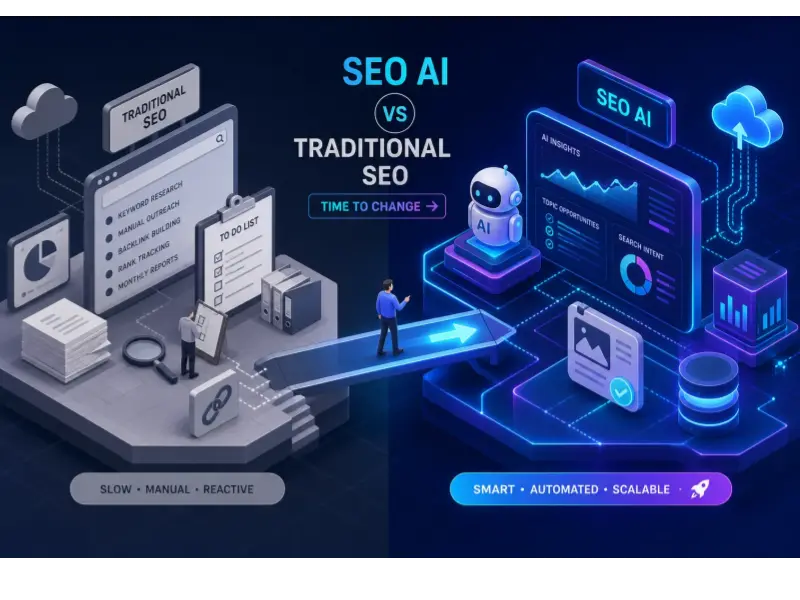
Traditional SEO is built around a specific mechanical sequence: crawl, index, rank. Google's bots discover your pages, store them in an index, and surface them based on signals like backlinks, on-page relevance, and domain authority. You optimize for that sequence, and you appear in search results. The model is well understood, and for the last 20 years, it's been the primary lever for online visibility.
LLMs don't work that way. When ChatGPT, Gemini, or Perplexity generates a business recommendation, it isn't retrieving a ranked list of pages from an index. It's synthesizing an answer from training data, retrieval-augmented context, and structured signals it can parse with confidence. A business can sit on page one of Google for every relevant keyword and still be completely absent from that generated answer. These are separate systems operating on separate logic, and performance in one does not transfer automatically to the other.
The shift from search results to AI-generated answers
High-intent local queries are moving away from traditional search faster than most business owners realize. When someone asks "which accountant in Calgary handles small business tax returns" or "who should I call for a licensed electrician in Vancouver," an increasing share of those queries now go directly into an AI chat tool. The buyer gets a recommendation, often with a brief explanation of why, and acts on it without ever opening a search results page. For referral-based service businesses, that's the moment of decision. If your name doesn't appear in that answer, you didn't lose the click. You were never in the conversation.
What traditional SEO was designed to do, and what it can't do now
Traditional SEO optimizes for document relevance to a query inside a crawled index. LLM retrieval-augmented generation, by contrast, combines semantic similarity, structured entity data, behavioral signals, and content metadata to synthesize a grounded recommendation. These aren't variations on the same process. They're different games with different rules. The point is not that traditional SEO no longer matters, it still does. The point is that AI for SEO visibility requires a separate, deliberate strategy that most service providers haven't started yet.
SEO AI signals: what LLMs actually use to recommend local service providers
Before you can fix your AI visibility, you need a clear picture of what these models actually evaluate. The signals fall into three broad categories: technical access, entity authority, and geographic relevance. Each one is independently capable of blocking you from appearing in AI-generated answers.
Technical access: can AI bots actually read your website?
Language models that use retrieval-augmented generation pull current web data through dedicated crawlers. OpenAI uses GPTBot, Perplexity uses PerplexityBot, and Anthropic uses ClaudeBot. If your website blocks these bots, your data never enters the retrieval layer. The problem is that many websites block them without anyone realizing it. A common culprit is a robots.txt file containing a wildcard rule like User-agent: * / Disallow: /, which blocks all bots, including AI crawlers, when no specific allow rule overrides it for each bot individually. CDN-level security configurations and aggressive bot-filtering plugins introduce the same problem. These blocks are typically added during site migrations or security hardening and are rarely audited afterward.
Entity authority: how LLMs verify who you are
LLMs need confident data to make confident recommendations. That confidence comes from consistent, structured entity signals. Specifically:
- Your business name, address, and phone number matching across directories
- Schema.org LocalBusiness markup on your website with complete fields, including service area, description, and aggregate rating
- Corroborating mentions across authoritative third-party sources
When these signals are missing or contradictory, the model either doesn't recognize your business as a distinct entity or may omit your name entirely rather than express uncertainty. A business that's well-known to its human customers can be effectively invisible to a language model.
Localized prompt hooks: matching what users actually ask AI tools
Buyers ask AI tools the same way they'd ask a trusted friend: "who's the best licensed contractor in Hamilton for a bathroom reno?" or "which physio clinic near downtown Toronto accepts Blue Cross?" Your content needs to provide semantic clarity that lets an LLM anchor your business to a specific service, in a specific geography, for a specific type of buyer. This is not keyword stuffing. It's about making sure that when a model processes a location-qualified service query, it has enough structured, natural-language evidence on your site to generate a recommendation with confidence.
The three gaps most referral-based businesses don't know they have
Most local service businesses that come to us for an AI visibility audit share one trait: they believe their digital presence is solid because their Google metrics look healthy. What they haven't checked is whether any of that presence is actually visible to AI systems. The same gaps show up repeatedly.
Bot-blocking configurations that silence your digital presence
Website security tools, CDN configurations, and CMS plugins can block AI crawlers without triggering any alert in Google Search Console. The site looks and performs normally to human visitors and to Googlebot, while GPTBot and PerplexityBot receive a 403 or are simply disallowed by a robots.txt rule. The business has no idea. Many clients discover this gap only when they request an audit and see the block in black and white. It's one of the most impactful and fastest-to-fix issues. AI Search Strategies complementary AI Accessibility Test checks the access status to 14 of the most common AI Crawlers, and provides a complementary report on which are blocked and which are allowed access to a business website.
Unstructured or inconsistent brand entity signals
A business that changed its name, rebranded, launched a new domain, or went through an ownership change often leaves a trail of contradictory data across directories. The old name shows on Yelp, the new name shows on Google Business Profile, and the website's Schema markup uses a shortened version that doesn't match either. Language models see conflicting signals and can't confidently associate any name with your actual business. They may default to omission rather than risk recommending the wrong entity. This gap is especially damaging because the business may have excellent reputation signals, they're just scattered under multiple identities the model can't reconcile.
Weak geographic anchors that let competitors own the local AI recommendation
Even a technically accessible website with a clear entity can fail to appear in location-specific AI recommendations if it lacks strong geographic semantic signals. If your content doesn't clearly and repeatedly connect your business to its service area using the natural language patterns buyers actually use in AI prompts, the model won't reliably include you when generating local recommendations. A competitor with stronger geographic content coverage can win the recommendation even when your Google ranking outperforms theirs, a dynamic that AI-driven SEO platforms are specifically built to address.
A starter implementation roadmap for getting AI-recommended
The order of operations matters here. Technical access is the foundation: if AI bots can't read your site, nothing else you do will have an effect. Once access is confirmed, entity clarity determines whether the model knows who you are. Localized content signals determine whether the model connects you to the right geography and buyer intent. The AI Search Strategies AI Visibility Engine 115-criteria implementation roadmap follows this exact sequence. To see a sample and evaluate the process on its merits, reach out to the AI Search Strategies team directly.
Fix 1: restore and configure AI bot access correctly
Start by reviewing your robots.txt file for wildcard and named blocks. Check specifically for GPTBot, PerplexityBot, and ClaudeBot listed alongside a Disallow directive. Also check for a wildcard rule (User-agent: * with Disallow: /) that doesn't have specific allow overrides for each of these bots above it. Next, review your CDN-level bot management settings and any security plugins in your CMS. The goal is explicit allow rules for each AI crawler, confirmed by loading your key service pages through a non-browser crawler emulator to verify they render completely.
Fix 2: build structured entity markup for your business
Implement LocalBusiness Schema on your homepage and each service location page. The fields that matter most for LLM entity recognition are: name, address, telephone, areaServed, description, and aggregateRating. Use the most specific LocalBusiness subtype available for your industry (HomeAndConstructionBusiness, Dentist, Accountant, etc.) rather than the generic type. Consistency between your Schema markup, your Google Business Profile, and your top directory listings is as important as the markup itself. Discrepancies across these sources undermine entity confidence and are a core focus of any serious AI content optimization effort.
Fix 3: create localized content anchors that trigger AI recommendations
Write service-plus-location page content that mirrors how real buyers phrase AI queries. A page that clearly answers "who provides [service] in [city]," "are they licensed and experienced," and "what do past past clients say" gives an LLM the grounded evidence it needs to generate a confident recommendation. Use natural, complete sentences rather than keyword strings. Include service area language, credential information, and genuine client outcomes. This is not about density, it's about semantic completeness, and it's a key principle behind effective AI keyword research tools and automated SEO software built for local visibility.
What this looks like in practice: two client examples
Tactics make more sense when you can see them applied to a real situation. Here are two cases that illustrate the gap between Google visibility and AI visibility, and what changed after the fix. Both are drawn from internal client work at AI Search Strategies and represent observed outcomes, not independently audited results.
A home renovation contractor who went from invisible to AI-recommended
A licensed general contractor in Ontario had strong Google rankings for renovation-related terms and a solid review profile, but inbound inquiries from new prospects had been declining steadily and AI-sourced leads were nonexistent. An audit found two problems: GPTBot was blocked at the CDN level through a security rule added during a site migration, and no service page on the site had any Schema markup. After resolving the CDN block and implementing LocalBusiness Schema with five service-specific pages, the contractor began appearing in ChatGPT responses for location-qualified renovation queries, and AI-referred prospects began reaching out within weeks of implementation.
A specialty healthcare provider that recovered AI citations after a rebrand
A specialty clinic in Ontario changed its operating name as part of a rebranding exercise. Shortly after, AI-generated referrals effectively stopped. The clinic's old name appeared across 40+ directories while the new name was only on the website and Google Business Profile. Language models couldn't reconcile the two identities and defaulted to not recommending either. The fix involved systematically updating NAP data across every major directory under the new name, implementing Schema markup consistently, and publishing a dedicated About page that documented the clinic's full history, credentials, and service continuity under the new identity. AI citation recovery followed within a month of completing the update.
How to find out where you stand before a competitor locks in the recommendation
The businesses that establish AI visibility now will be the hardest to displace later. Once a competitor's entity is strongly anchored in a model's retrieval layer, displacing them requires considerably more effort, a dynamic consistent with how retrieval-augmented systems reinforce established signals over time. The time to act is before that pattern is established, not after.
What the AI Visibility Shield Audit covers
The AI Search Strategies AI Visibility Shield Audit is a manual expert analysis of your business digital presence across 50 AISO criteria. It covers technical bot access, entity authority, Schema implementation, semantic signals, localized prompt alignment, and competitive AI recommendation gaps in your market. It's a human-expert review that delivers a prioritized implementation roadmap within 4 business days. The roadmap tells you exactly what to fix, in what order, and what outcome to expect from each intervention.
Early positioning creates a permanent authority advantage in AI discovery.
The businesses that establish structured AI visibility today will be the most resilient against competitor displacement tomorrow. Once a competing firm becomes deeply anchored inside an engine's retrieval layer, displacing that recommendation requires significantly more technical effort. Every day your digital footprint remains unoptimized, inconsistent, or blocked from AI crawlers, prospective clients asking conversational tools for local recommendations are systematically routed to competing service providers.
Uncover your top AI visibility opportunities with a complimentary Quick-Win Review.
Evaluating your digital presence for AI search does not require complex, multi-week diagnostics or overwhelming technical reports. Through our complimentary AI Visibility Quick-Win Review, our team conducts a live analysis directly on your website to uncover three to five practical, high-impact opportunities you can begin addressing immediately to strengthen your machine readability and recommendation frequency.
If you want to ensure your firm is understood, trusted, and actively recommended when high-intent buyers prompt AI platforms, visit the AI Visibility Quick-Win Review to book your live review session. Uncovering these practical adjustments today is the fastest way to capture new client opportunities before a competitor locks in the local AI recommendation.
Is your business invisible to AI?
Get a manual expert analysis to uncover why you aren't being recommended.
Get Your Free AI Visibility Quick Win Review