
Can I Do AI Search Optimization Myself or Do I Need to Hire Someone?
Authors


Can I Do AI Search Optimization Myself or Do I Need to Hire Someone?
The way your future clients find your business has fundamentally changed. Instead of scrolling through pages of blue links on traditional search engine results, a rapidly growing number of consumers are asking conversational AI assistants like ChatGPT, Gemini, and Perplexity to recommend the absolute best providers in their region.
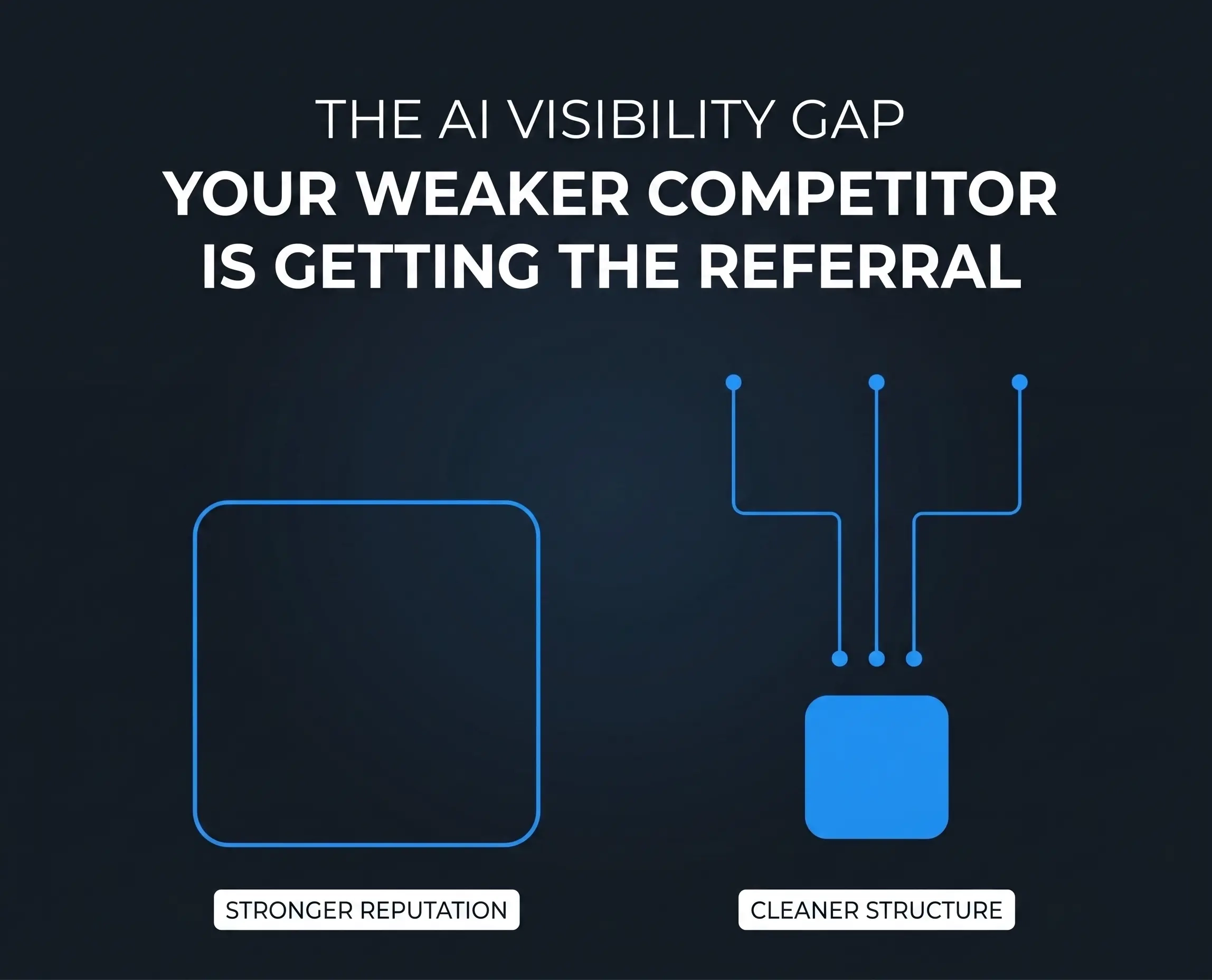
Go ahead and test this right now with a simple, unbranded prompt: "Recommend the best [enter your business type] firm/practice in [Your City]." If you run that test and your business is completely omitted from the recommendations, you have a massive visibility gap. Even worse, you might see an inferior competitor listed above you, someone you know does sub-par work compared to your decades of earned experience. This happens because of a harsh algorithmic reality: AI does not automatically recommend the best business; it recommends the business it understands best.
If your digital footprint is not sending the right signals, AI will bypass you. This leaves many established local market leaders asking a critical question: Can I handle AI Search Optimization (AISO) myself, or do I need to hire a professional?
The simple answer is yes, you can technically do parts of it yourself. But the deeper, strategic answer is that a complete Do-It-Yourself (DIY) approach is often a trap that burns your valuable operational hours and leaves your brand digitally invisible.
The DIY Line in the Sand: What You Should Own
As a specialized professional or practitioner, you are the ultimate domain expert in your field. Because of that, you absolutely should be heavily involved in the strategic, front-facing elements of your marketing footprint.
You should be the one ensuring that your core business strategy, your unique perspective, and your real-world expertise are clearly and authoritatively communicated across your website and digital assets. No one knows your clients and your vertical better than you do. Taking the time to clearly articulate your core message on your public channels is not a problem at all. It is actually much better if you are the one driving that narrative.
However, a dangerous line exists where business owners cross over from managing their message to wrestling with complex technical infrastructure.
The Technical Trap: Where Simple Scales and Fancy Fails
When it comes to the technical backend of AISO, the DIY model completely breaks down. True optimization for large language models requires an intricate programming infrastructure that goes far beyond writing good content. It requires deeply advanced, custom-coded structural data, known as schema, along with specialized directives like advanced robots configurations, detailed linking networks, and machine-readable data nodes.
These background elements must be precisely coded to translate, amplify, and link your real-world business assets directly to your website in a language that AI spiders can instantly digest.
Many owners fall into the "checked box" illusion. For instance, we recently ran the AI Visibility Shield Audit on a medical clinic in Ottawa, Ontario, that technically had Organization schema in place. On the surface, the owner thought the technical box was checked. However, when our team analyzed the code, we found it was just a generic, surface-level schema automatically generated by a standard online plugin or web host.
While generic schema provides a tiny bit of baseline value, it completely misses the strategic opportunity. To actually win recommendations, you need a deep, custom, complex schema built by an expert who understands the exact architecture of technical AI search optimization infrastructure. Amateurs deploy surface-level solutions; experienced professionals execute deep strategic implementations.
The Story of an Invisible Entity
When technical infrastructure breaks down, language models cannot bridge the gap on their own. We saw this firsthand with a specialized healthcare clinic in Toronto, Ontario.
The clinic had recently changed its business name and website domain. Because their former brand had spent years accumulating strong authority and digital trust, the sudden name change caused a massive disconnect in the eyes of conversational AI. Language models could no longer map the old reputation to the new web footprint, causing the clinic to instantly lose its visibility in both AI recommendations and organic search.
To fix this AI Visibility Gap(TM), our team stepped in to rebuild the technical backend infrastructure. We wrote custom, highly advanced schema to interlink the data trails, systematically proving to the AI engines that this new business name was actually the exact same entity as the old business name. By repairing that broken entity bridge, we rescued and transferred the clinic's historical reputation, experience, and authority signals.
Additionally, we utilized advanced schema to structurally nest the individual practitioners who worked inside the organization. The clinic heavily relied on the immense authority and expertise of the main doctor who founded it, but they also housed other specialized practitioners. By structurally linking those separate professionals to the main organization's node in a programming language the AI trusted, we amplified the entire firm's collective strength. The result was a dramatic performance boost across major conversational search experiences.
The Hidden Cost of Doing Nothing
Trying to figure out deep technical coding on your own takes you completely away from your actual zone of genius. Every hour a lawyer, doctor, or premium contractor spends trying to learn data engineering is an hour stolen from billable work and executive growth.
Worse yet, staying invisible or relying on generic templates leaves you completely exposed to algorithmic vulnerabilities and machine hallucinations. We frequently see cases where an AI engine attempts to summarize an elite, top-tier local business but completely hallucinates the facts, falsely labeling them as a "small-scale, limited local operation" simply because it cannot find structured evidence to verify the truth.
When AI actively spreads false or minimizing data about your company behind your back, you lose premium client opportunities for no reason at all. Ensuring your digital presence accurately reflects your hard-earned, real-world reputation is not about trying to trick a system, it is an act of professional responsibility to protect your brand. Clear communication and advanced structured data handled by a knowledgeable professional insulate your business from these risks.
Uncover Your AI Visibility Gap
If you want to stop guessing what conversational engines think about your business, you need objective data over empty agency promises. You do not need to look at another confusing legacy SEO report filled with vanity keyword metrics that do not translate to actual phone calls.
You just need to know if AI can find, verify, and trust your company today.
To help you gain absolute clarity without wasting your time, AI Search Strategies has developed a streamlined diagnostic tool designed specifically for busy business owners.
By visiting our dedicated link, you can request a complimentary AI Visibility Snapshot(TM). This is a plain-English, executive assessment that scans the five most critical technical factors dictating whether language models can smoothly discover your assets, interpret your data, validate your authority, and confidently output your company name in live client recommendations. Take the test today to close your visibility gap before it becomes a permanent competitive disadvantage.
Is your business invisible to AI?
Get a manual expert analysis to uncover why you aren't being recommended.
Get Your Free AI Visibility Report