
HubSpot vs. SearchAtlas vs. AI Search Strategies: Which AI Search Optimization Architecture Builds Permanent Equity?
Authors


Why Most Businesses Choose the Wrong AEO Architecture: As the zero-click funnel becomes the primary touchpoint for customer acquisition, businesses must decide how to interface with AI models like ChatGPT, Gemini, and Perplexity. This article analyzes three distinct architectural categories: Observation (HubSpot), Automation (SearchAtlas), and Infrastructure (AI Search Strategies). The objective is to determine which approach aligns with your current business stage and long-term capital goals.
The Landscape: Why AI Models Ignore Your Brand (It's Not a Content Problem)
For years, digital marketing relied on the click-through model. Today, AI models synthesize answers directly and often bypass your website entirely. This shift has turned AI Search Optimization from a marketing tactic into a piece of core digital infrastructure.
If your brand is missing from an AI recommendation set, the problem is rarely a lack of content. Usually, it is a failure of machine readability. This is a technical barrier preventing the AI from verifying who you are and why you should be trusted.
To navigate this, we compare three market-leading approaches.
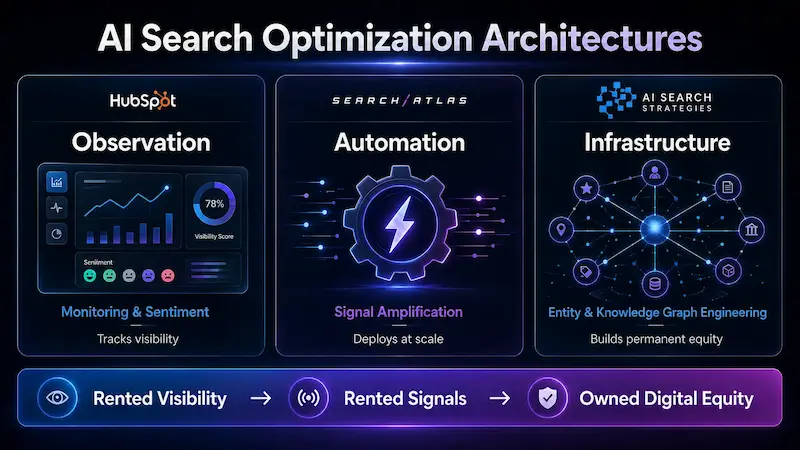
1. HubSpot AEO Hub Explained: What AI Search Monitoring Can and Cannot Diagnose
HubSpot approaches AI Search as an extension of the CRM. Their Answer Engine Optimization (AEO) Hub is designed primarily for monitoring and sentiment analysis.
- The Technical Logic: It uses CRM-connected data to track share of model (how often you appear) and sentiment (how you are described). It provides prompt-engineering suggestions to help marketers create content that targets AI responses.
- Best For: The discovery phase. It is an ideal tool for firms that need to establish a baseline and understand their current visibility without necessarily re-engineering their website.
- The ROI Limit: HubSpot monitors symptoms rather than diagnosing root causes. It can identify that visibility is low, but it cannot identify the reason. It will not find a Web Application Firewall (WAF) blocking a grounding bot or a semantic conflict in the global knowledge graph.
2. SearchAtlas OTTO Review: How JavaScript-Based AEO Automation Works and Where It Fails
SearchAtlas focuses on signal amplification. Their OTTO agent is built for speed and high-volume deployment of SEO and AEO signals.
- The Technical Logic: OTTO uses a JavaScript pixel to overlay optimizations onto a website. It automates schema injection, meta-data updates, and content generation. This allows a firm to complete months of traditional optimization work in minutes.
- Best For: The rapid deployment phase. It serves businesses that need broad coverage across many keywords quickly and are comfortable with an automation-first workflow.
- The ROI Limit: This is often rented equity. Because the optimizations are frequently rendered via JavaScript, they may vanish if the subscription ends or the pixel is removed. Furthermore, many AI crawlers index pre-rendered HTML. If they do not execute the JavaScript, the automated optimizations remain invisible to the model.
3. AI Search Strategies Infrastructure-Level AEO: How Entity Reconciliation and Wikidata QIDs Build AI Visibility You Own
At AI Search Strategies, we treat AI visibility as a structural engineering problem. Our focus is on entity reconciliation and permanent equity.
- The Technical Logic: We execute a 100+ point diagnostic that goes beyond the website to audit the global knowledge graph. We identify and fix edge-layer lockouts, resolve entity collisions (where AI confuses your brand with a common noun), and establish deterministic identifiers like Wikidata QIDs.
- The ROI of Permanent Equity: Unlike subscription-based overlays, infrastructure engineering creates a permanent digital asset. When we reconcile your entity across the web or fix a server configuration, those improvements become a part of your business's permanent equity. They continue to function long after the initial implementation is complete. This shifts the cost from a recurring marketing expense to a long-term capital investment.
- Best For: The permanent foundation phase. This is for managing partners who want to build a brand that owns its authority independently of a monthly software subscription.
How to Evaluate Any AI Search Optimization Provider: Two Questions That Reveal Everything
To determine which architectural approach you are receiving, ask any prospective provider these two questions.
Question 1: What happens to our visibility if we stop paying?
- HubSpot: Your monitoring stops and your visibility remains at its current baseline.
- SearchAtlas: Your amplified signals may disappear if they rely on the active JavaScript pixel.
- AI Search Strategies: You own the equity. The technical fixes, entity reconciliations, and Wikidata entries are permanent. The infrastructure is yours.
Question 2: If the AI fails to recommend us, how do you diagnose the failure?
- The Observer (HubSpot): Will suggest more content to try and gain the model's attention.
- The Automator (SearchAtlas): Will deploy more schema to increase signal volume.
- The Engineer (AI Search Strategies): Will perform a deep-packet audit to check for crawler blocks or a semantic audit to resolve identity conflicts in the knowledge graph.
HubSpot vs. SearchAtlas vs. AI Search Strategies: AEO Platform Comparison by Architecture Type
| Feature | HubSpot (Observation) | SearchAtlas (Automation) | AISS (Architecture) |
|---|---|---|---|
| Primary Goal | Monitor and Track | Scale and Speed | Precision and Permanence |
| Deployment | CRM Dashboard | JavaScript Pixel | Infrastructure Hard-Coding |
| Data Ownership | Rented (Analytics) | Rented (Signals) | Owned (Equity) |
| Root Cause Fixes | No | Partially | Yes |
| Best Stage | Initial Discovery | Rapid Growth | Permanent Foundation |
Which AI Search Optimization Strategy Matches Your Business Stage?
- If your goal is to understand the landscape, start with HubSpot.
- If your goal is to saturate the market with content quickly, use SearchAtlas.
- If your goal is to resolve technical barriers and build a permanent, high-authority brand that AI models trust by default, AI Search Strategies is the correct architectural choice.
Ready to move from observation to architecture? Let's audit your infrastructure.
Is Your Current Setup Building Equity?
Get our manual expert analysis to uncover if you are just producing noise or if you're actually building machine-readable authority.
Get Your AI Visibility SnapshotStop letting 'weaker' competitors claim the digital equity you’ve spent years building. Every time an AI tool recommends them over you, you’re losing a high-intent lead. Claim your AI Visibility Audit today.
FAQ Section
Q: What is entity reconciliation in AI Search Optimization?
Entity reconciliation is the process of resolving conflicts in the global knowledge graph where AI models misidentify or confuse your brand. This includes fixing cases where an AI conflates your company name with a common noun, a competitor, or an unrelated organization. Deterministic identifiers like Wikidata QIDs anchor your brand's identity permanently across the web.
Q: Does JavaScript-injected schema get read by AI crawlers?
Not reliably. Many AI crawlers, including those used by Perplexity and Bing-based models, index pre-rendered HTML rather than executing JavaScript. This means schema injected via a JavaScript pixel: such as SearchAtlas OTTO's overlay method: may be invisible to the model entirely, limiting the effectiveness of automation-first AEO strategies.
Q: What is "share of model" and how is it measured?
Share of model refers to how frequently your brand appears in AI-generated responses across a defined set of prompts relevant to your industry. Tools like HubSpot's AEO Hub track this alongside sentiment: how positively or neutrally the brand is described. It functions as a visibility metric, similar to share of voice in traditional media.
Q: What is the difference between AEO and AI Search Optimization?
Answer Engine Optimization (AEO) traditionally focused on optimizing content for featured snippets and voice search. AI Search Optimization (AISO) extends this to include the full technical layer: entity verification, knowledge graph accuracy, crawler access, and server-level configurations that determine whether an AI model can even read and trust your brand's data.
Q: Why does a Web Application Firewall (WAF) affect AI visibility?
AI grounding bots and crawlers often use IP ranges or user-agent strings that aggressive WAF configurations flag and block. If a model cannot crawl and verify your site, it will not include you in its recommendation set: regardless of how good your content is. This is a common root cause of low AI visibility that content-focused tools never detect.
Is your business invisible to AI?
Get a manual expert analysis to uncover why you aren't being recommended.
Get Your Free AI Visibility Report